lifelong learning (and stitching)
slow, quiet note no. 66

It felt great to get back to teaching in person again last week - spending a couple of hours every Monday morning sharing my love for all things stitch has become an important and positive thread weaving through the rest of my creative practice.
My Monday morning classes are a six minute walk from my front door, five if I stride purposefully across the allotments. If I manage to refrain from packing too much stuff, I can comfortably balance sufficient materials and resources across two large tote bags leaving a hand spare should an umbrella be required.
Logistics aside, as well as creating what I hope are interesting and enriching workshops and classes, one of the things I love most about teaching is that it fuels my own enthusiasm for learning. Specifically, learning for learning’s sake and by that, I mean learning for enjoyment, for pleasure and just because you want to.
I realised a long time ago that I love to learn - my natural away-from-home habitats are bookshops, libraries, museums and galleries (not forgetting, of course, slightly chilly village halls where you can come across experts in all sorts of subjects and have the pleasure of listening to them whilst balancing a notebook, a tepid cup of tea and squinting at a slightly fuzzy powerpoint presentation).
Before I went back to college in my forties, I read a book called ‘What do I do if I want to do everything?’ by the late Barbara Sher. Her advice was liberating, particularly her strategy for avoiding overwhelm. One particular nugget was to begin by making a list of subjects you were most definitely NOT interested in.
I found this useful at the time and continue to do so. Having practiced this list making over the years, I make no apology for being blissfully uninterested in extending my knowledge on a number of subjects - spreadsheets, sport and space travel to name but three.
Some might say that this is a failing, or perhaps a negative approach to take, there is so much to be interested in, so many wonders in the world, so much knowledge. I agree, I do, but there are only so many hours in the day and days in the life and there simply isn’t time to be interested in every single thing.
I think what is important is to be interested in some things. Really interested and to enjoy finding out and knowing stuff about whatever that subject is even if other people aren’t in the slightest bit bothered about it. Some might consider your particular subject of interest a bit odd, unusual, a little too academic or philosophical, impractical or downright useless.
Who cares? You do.
You might be fascinated by pre-historic weaving tools or the complex components of 1960s Rolex watches, your best friend might be an expert in fourteenth century agricultural practices - for me, what is interesting is being interested and, crucially, enjoying the pursuit of that interest.
I think there is more to write about this and it’s something I will return to but for now, apologies….let’s get back to the matter in hand….
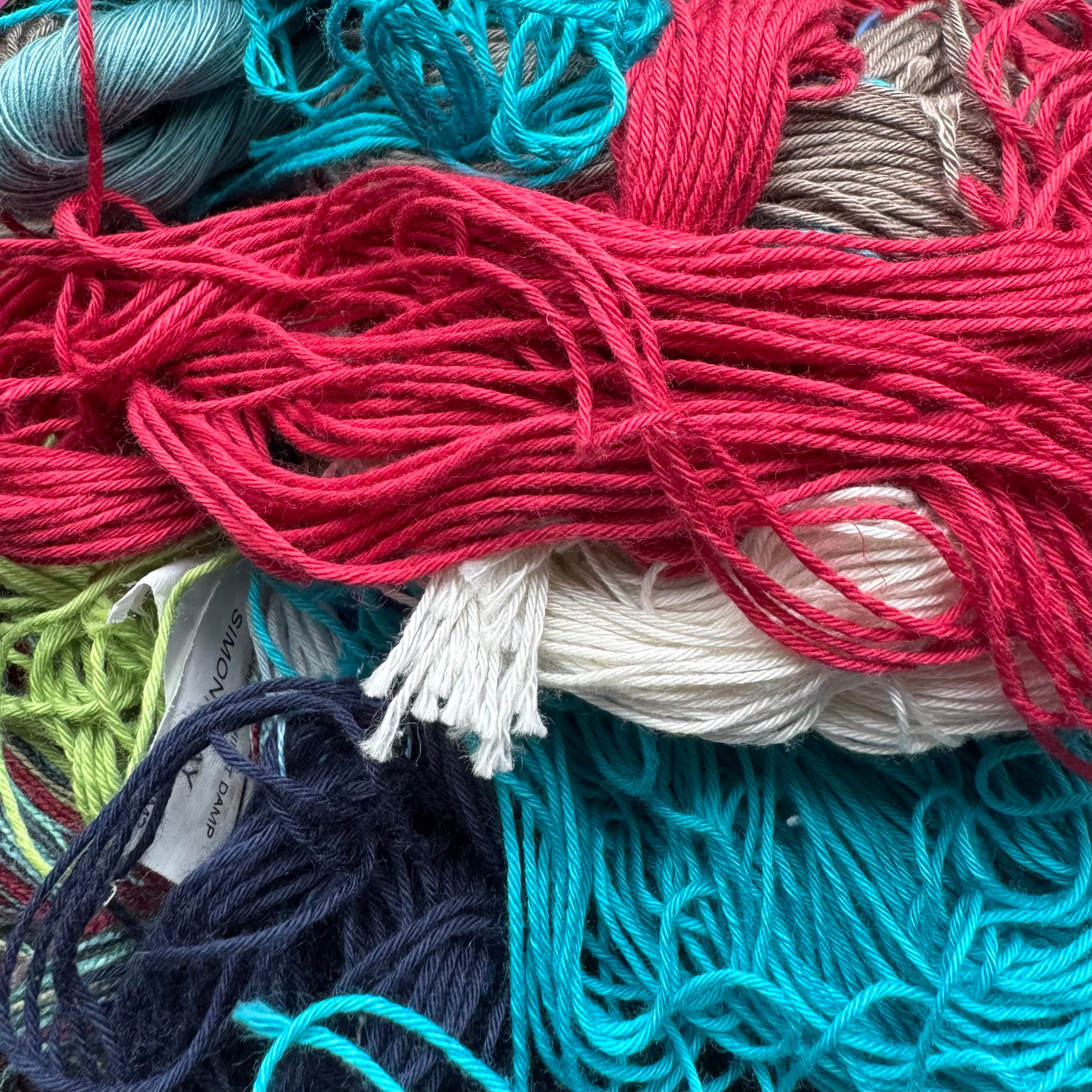
As a development from our regular Monday workshop embroidery practice, we have started to explore the patterns and traditions of Japanese sashiko stitching. We have taken a break from using stranded embroidery floss and have been working with the traditional cotton thread which is twisted and has a matte finish as I hope you can see in the photograph above.
I have been interested in the Japanese textile traditions of sashiko and boro for many years and was lucky to catch The Japanese Art of Recycling at the Brunei Gallery in London a couple of years ago. I am, however, by no means an expert on the subject. I am drawn to the history of persistent and enduring repair, so clearly visible in garments and objects that are hundreds of years old, layered with fabrics secured by tiny stitches, patched and re-patched over and over again. I also love the decorative beauty of complex patterns handed down and extended over the years, constructed by the repetition of what is, essentially, a simple running stitch.
Sharing my interest and knowledge of the subject in our recent workshops has prompted me to look through my own work and pull out some of the pieces that have been inspired by those traditions. Although my work is often layered with prints and pattern, my anchoring stitches are usually very simple and most often I return to running stitch whether I’m quilting, collaging or drawing.
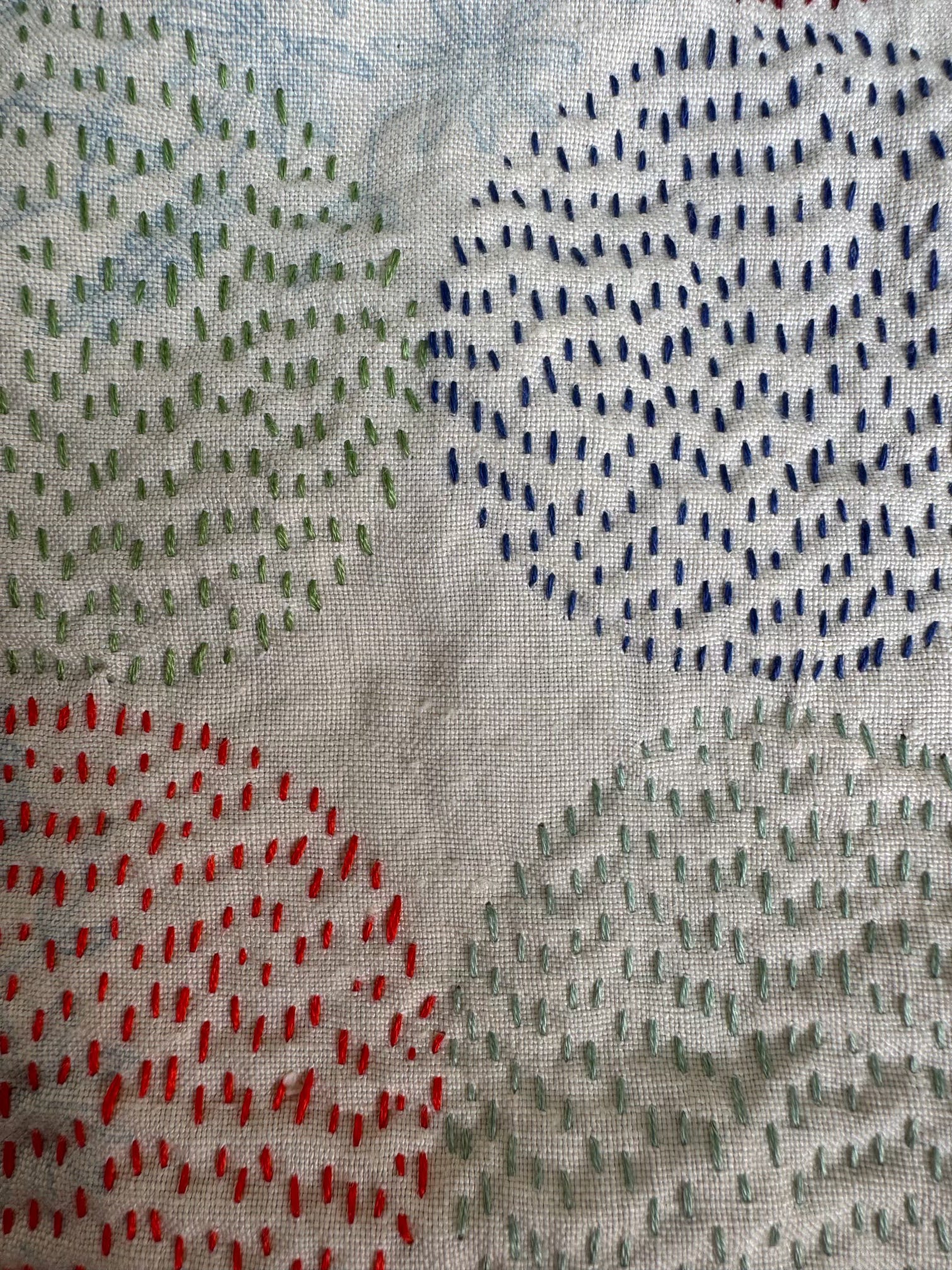
I have also enjoyed gathering together, working with and sharing my much-loved collection of sashiko threads. As part of my introduction, I managed to demonstrate how to unravel and organise a sashiko thread skein just about successfully (do not follow my example in the tin pictured above).
There is a knack to this that is worth spending the time to learn and I often return to this useful tutorial from wrenbirdarts when I need to remind myself how to do it properly:
The history and cultural significance of sashiko are fascinating and if you are interested in learning more, you could start by looking at this brief history by Claudia Martinez. I also found an informative link on the Embroiderers Guild of America website which has some useful links and resources. There are also many suppliers of threads, fabrics, samplers and patterns to choose from and here in the UK we have Japan Crafts, Loop London and Beyond Measure.
In other news I would say I have done more drawing than stitching this week and this is unusual to say the least. I have no idea where this unexpected diversion is heading but your eyes will be relieved to know that I have even less inclination to share much of it here.
I think it might be a change of pace thing. Now that I can breathe through my nose again with neither hindrance nor obstruction, I am enjoying filling page after page of that flimsy notebook I bought last week with speedy, scribbly and, frankly, daft drawings while watching the telly in the evenings. The interesting thing, however, is that I am really enjoying it and this means I need to keep doing it at least for a while, just to see where it goes. Perhaps I will pursue it, perhaps not, but for now, like my head cold, I’ll try to keep most of the attempts to myself.
As I’ve been able to resume normal outings and activities this week you might assume that my screentime would have dwindled but I have inadvertently fallen down an online rabbit hole, having discovered The Modern House and Inigo channel on Youtube.
I think I am very late to this particular house party but The Modern House, a UK-based estate agency who ‘sell homes with authentic details and compelling stories’ provide many beautifully produced films, interviews and house tours for those of us who like to look at, if not purchase beautiful and I mean beautiful homes. I particularly enjoyed this podcast episode with fashion designer and artist Zandra Rhodes who is currently the subject of an exhibition at the Holbourne Museum, just up the road from me in Bath.
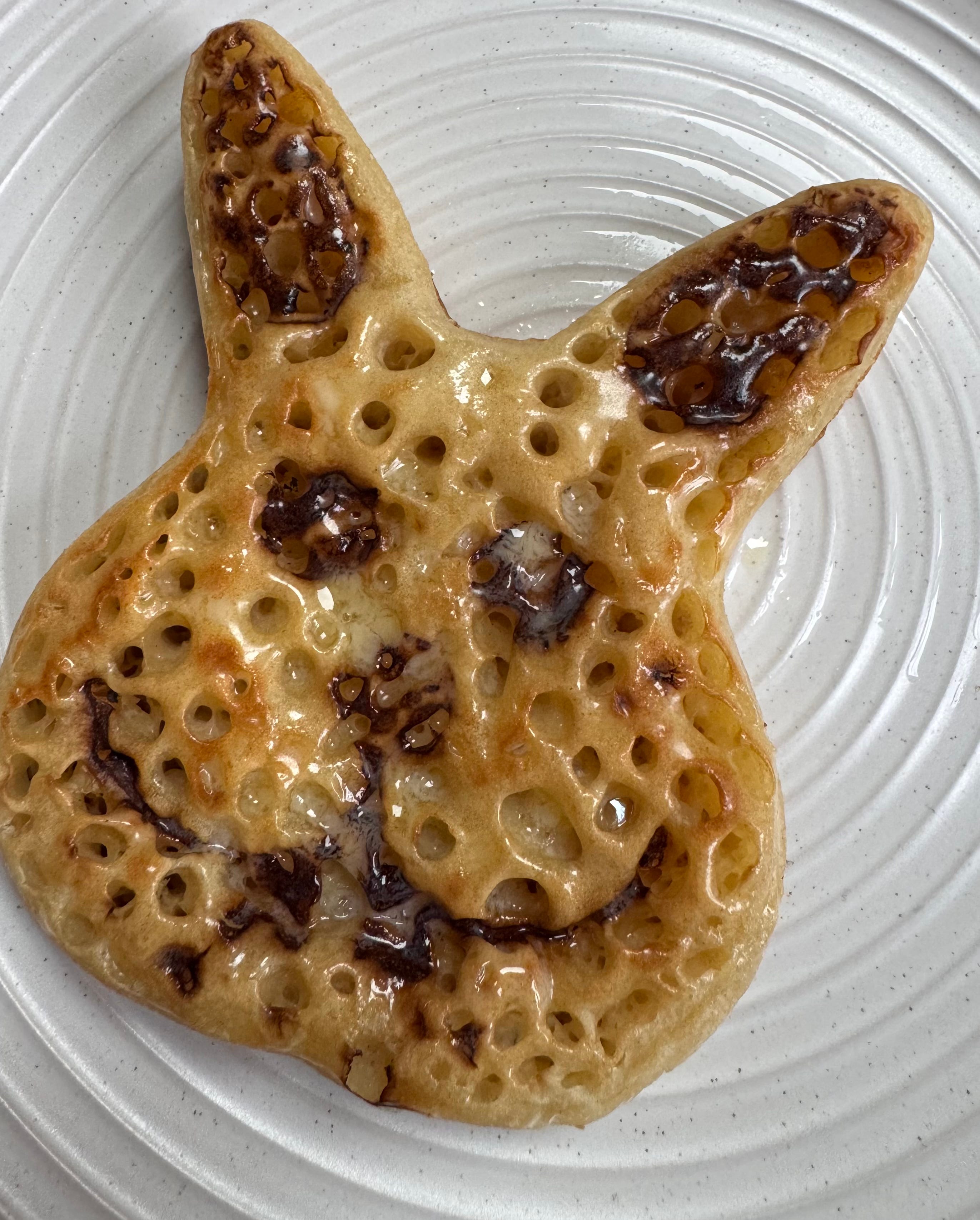
As balance to such carefully curated interiors and architectural gorgeousness I leave you with this, a perfectly toasted, salty-buttered leporine crumpet - who needs rhubarb and custard hot cross buns anyway?
Happy Easter!
Thank you for taking the time to read this week’s slow, quiet note and welcome to those of you who have followed or subscribed recently - it’s great to meet you.
These weekly Sunday posts are free to read but if you would like to support my writing further, you could choose to buy me a coffee.
Or you can help me connect with other writers and artists here by simply taking the time to scroll down a little further and to like, restack or share this post.
Have a great week!
Janice x
I love the idea of list of non-interests! Also want to suggest the work of 3rd generation Japanese sashiko artisan Atsushi Futatsuya for a deeper understanding of sashiko from a cultural perspective. He has a youtube channel, a really deep Patreon where he writes about the sashiko his family practices, and has a book coming out later this year.
Thanks for sharing! I'm going to hunt down a copy of "What to do when I want to do everything" for sure. The learning list I keep has three categories, 1. Things I devote deep study to (weaving, and the like) 2. Things I can do without having to did too deep (spinning-if it like like a yarn, I'm happy) and 3. Things I won't touch, to make sure I have time for the first two categories (I will never knit, and that's okay!)